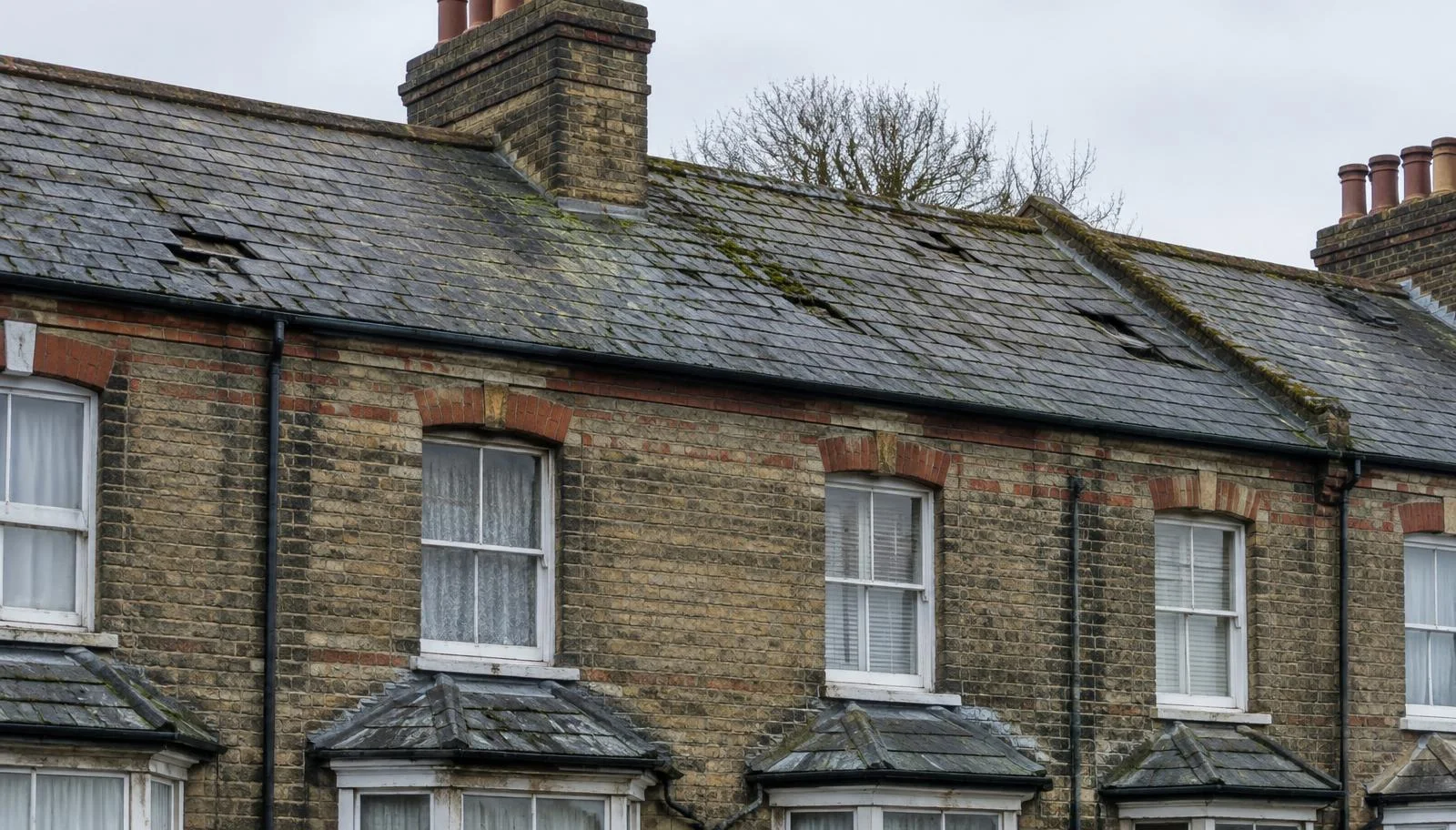
Finding the words “roof requires replacement” in a survey can make it sound as though the mortgage is finished.
It may not be.
The lender is unlikely to be concerned simply because a roof is old. The important questions are what has failed, whether the property remains habitable and structurally sound, how the defect affects value and saleability, and what needs to happen to put it right.
There is also a major difference between a roof covering reaching the end of its useful life and the supporting roof structure itself failing.
A Victorian house needing its slates stripped and renewed is not automatically the same mortgage risk as a property with badly deflected rafters, roof spread and movement to the supporting walls. Roof spread is outward movement at the tops of supporting walls where the roof structure is not adequately restrained against the horizontal forces generated by the rafters. It can be associated with altered or inadequate ties, failed structural members or other defects, but ordinary roof sagging does not automatically mean active roof spread.
If a roof defect has already caused a problem with the valuation, FG & Cook’s specialist lending service deals with property defects, valuation difficulties and cases that fall outside straightforward lender criteria.
Does needing a new roof stop you getting a mortgage?
Needing roof work does not automatically stop a mortgage.
Halifax’s current property-condition criteria are a useful example of how lenders approach the issue. It requires property used as mortgage security to be habitable, readily saleable, structurally sound and capable of having buildings insurance arranged. If works are needed to bring a property to an acceptable condition, Halifax says that some or all of the mortgage advance may be retained until those works are completed.
That is Halifax’s current approach, not a rule followed identically by every mortgage lender. Another lender might accept the property without a retention, request more information, reduce the value it is prepared to rely upon, impose different conditions or decide the property does not meet its security requirements.
Much depends on what “new roof” means in practice.
What does “needs a new roof” actually mean?
It is an imprecise phrase.
A surveyor might be describing:
- slipped, cracked or deteriorated tiles or slates;
- an ageing roof covering approaching the end of its economic life;
- failing underfelt or membrane;
- defective flashings;
- widespread previous patch repairs;
- water penetration;
- defective flat-roof coverings;
- inadequate detailing around chimneys, valleys or abutments;
- deterioration to battens or roof timbers;
- significant deflection or failure of structural members.
Those findings do not all have the same mortgage significance.
An old covering can sometimes remain weatherproof despite having limited remaining life. Conversely, a roof that looks reasonably tidy from the street can conceal leakage, decay or structural alteration.
The age of the covering is therefore useful information, but age alone does not establish that replacement is immediately required.
What matters is condition and performance.
Why does the roof structure matter?
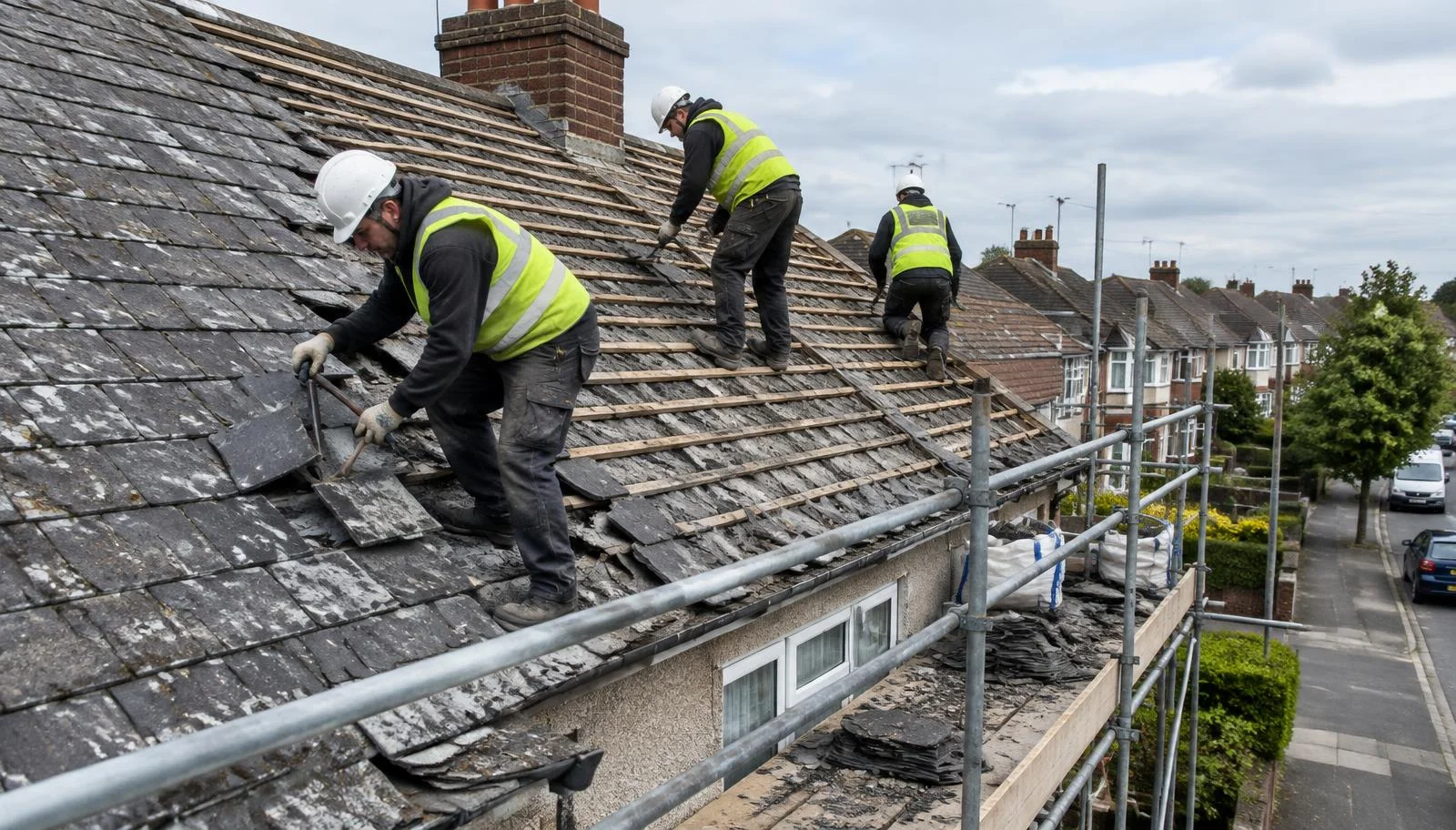
The roof covering is only one part of the roof.
Tiles, slates, membranes and flashings keep the weather out. Beneath them, rafters, trusses, purlins and other structural components support the roof and transfer its loads through the building.
A worn covering is primarily a repair and maintenance problem.
Significant failure of the supporting structure can become a structural and valuation problem.
Noticeable roof deflection might result from longstanding construction characteristics and be stable, or it could be associated with undersized members, removed supports, inappropriate alterations, failed restraint or deterioration. The cause matters.
Current Halifax guidance specifically lists roof deflection among examples of defects for which its valuer may request a focused structural report where further investigation is needed.
That does not mean every sagging roof needs an engineer. It means that where the valuer cannot safely reach a lending conclusion from what can be seen, more evidence may be required.
What can the mortgage lender do?
There is no single outcome.
Depending on the roof defect and the lender’s criteria, the mortgage valuation could result in:
- no lending condition at all;
- a recommendation for the buyer to investigate the roof separately;
- a specialist report being requested;
- the property being valued below the agreed purchase price;
- part of the mortgage advance being retained;
- the full advance being withheld until essential works are completed;
- the property being considered unsuitable security in its present condition.
Halifax’s current criteria confirm that its mortgage advance can be wholly or partially retained where work is needed to bring a property into suitable lending condition.
This matters because a lender agreeing that a property may ultimately be acceptable does not necessarily mean the buyer will receive all of the expected mortgage funds on completion day.
A quick way to understand the possible outcomes
| Roof condition / issue | What matters to the lender | Possible next step |
|---|---|---|
| Ageing but serviceable covering | Current weather-tightness, value and remaining maintenance burden | No condition, or buyer advised to budget for future renewal |
| Active leakage or widespread covering failure | Habitability, deterioration and effect on value | Further evidence, repairs, retention or another lender-specific condition |
| Significant deflection or suspected structural failure | Structural soundness and saleability | Focused structural investigation may be requested |
| Shared roof to a leasehold block | Repair responsibility, planned works and financial exposure | Conveyancing enquiries and lender review of the specific circumstances |
These are examples of possible pathways, not universal lender rules.
How does a mortgage retention work?
A mortgage retention is where the lender holds back part of the mortgage advance until specified work has been completed satisfactorily.
Imagine you agree to buy a property for £300,000.
You planned to provide a £30,000 deposit and borrow £270,000.
If the lender agreed the mortgage but retained £15,000 pending essential roof work, it would not necessarily mean the seller receives £270,000 from the lender at completion and you sort the roof later.
The buyer may need substantially more cash to bridge the funding gap, negotiate with the seller, arrange for work to happen before completion or find another lending solution.
The exact mechanics depend on the lender and transaction, and the £15,000 figure is purely an illustration. There is no standard roof-retention amount.
A retention should therefore be treated as a funding issue, not merely a technical note buried in the valuation.
Is a retention the same as a down-valuation?
A retention and a down-valuation solve different lender concerns.
A down-valuation means the lender considers the property’s current market value to be lower than the price being paid.
A retention means part of the mortgage advance is being withheld pending specified works or evidence.
It is possible for a defect to affect the valuation, lead to a retention, or potentially do both depending on the circumstances and lender.
For example, a lender might consider a property worth £300,000 once repaired but be unwilling to release its full advance while serious water penetration remains unresolved.
Alternatively, the valuer might conclude that the roof’s condition reduces what the property is worth today.
From the buyer’s perspective, both can mean needing more cash or renegotiating the purchase, but they are not the same lending decision.
Will you need a specialist roof or structural report?
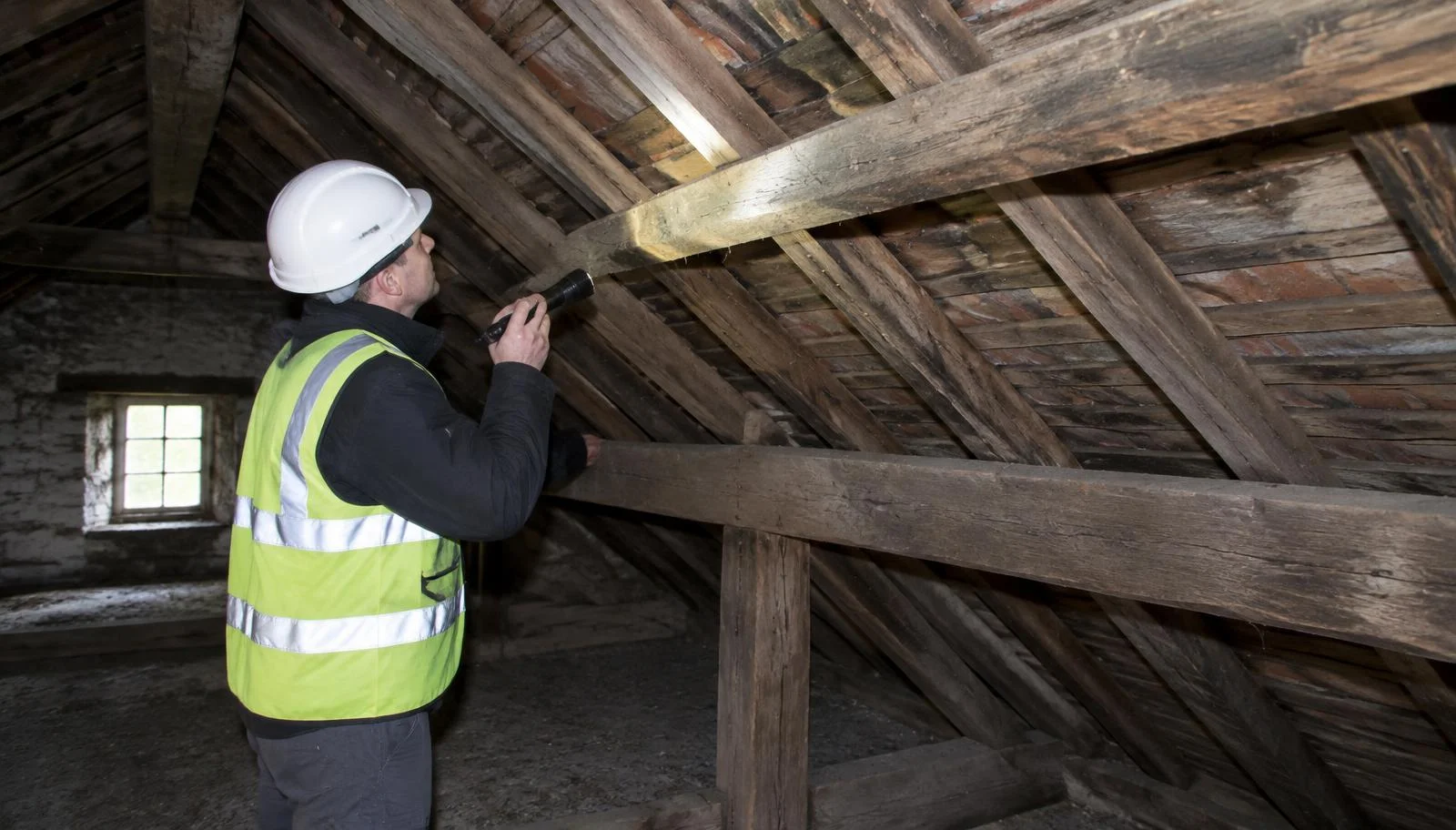
Sometimes, but the type of report should follow the defect.
A survey stating that a covering is old and should be renewed is not, by itself, a reason to commission a structural engineer.
If the issue is principally the condition of roof tiles, slates, membranes or flashings, an experienced roofing contractor may be able to provide an appropriate specification and quotation.
If there is significant roof deflection, suspected structural movement, failed supports or uncertainty about alterations to the roof structure, a focused structural assessment may be more appropriate.
Halifax currently says that where serious or potentially serious defects prevent its valuer reaching a conclusion, it may request a specialist report. Its guidance specifically says that a structural-engineer report should focus on the defect referred to, with roof deflection given as one of its examples.
Commissioning a costly structural investigation without first understanding what the lender or surveyor needs answered can waste money.
What if the mortgage valuation says nothing about the roof?
Silence in the mortgage valuation does not prove the roof is sound.
Nationwide currently explains that its mortgage valuation may involve a physical inspection, an external-only assessment, a desktop valuation or an automated valuation model. It expressly warns borrowers not to rely on the mortgage valuation to identify defects.
RICS makes the same broader distinction: a lender’s valuation is a limited check undertaken for the mortgage provider and is not a Home Survey for the buyer.
RICS valuation guidance also says that a roof-space inspection is not automatically required for a mortgage valuation; where a valuer considers one essential because it may materially affect value, the inspection may be limited.
Your own survey might therefore identify a major roof problem that the lender’s valuation has not mentioned at all.
Do not interpret that silence as the lender having inspected the roof and approved its condition.
What if the seller offers to replace the roof?
That can solve the practical problem, but the detail matters.
You need to know what work is actually proposed.
“New roof” could mean stripping and renewing the complete covering, replacing only the front slope, applying another flat-roof layer, repairing defective timbers, or simply undertaking enough patch work to stop an obvious leak.
If substantial work is being carried out before you buy, obtain appropriate documentation. Depending on the work, that could include:
- the contractor’s quotation and specification;
- invoices;
- details of materials used;
- photographs of concealed work where useful;
- any applicable Building Regulations documentation;
- guarantees or warranties;
- structural information where alterations were necessary.
In England, Building Regulations approval can become relevant to substantial reroofing, structural alterations or changes that materially affect the roof’s performance. Planning Portal guidance says approval is normally needed where more than 50% of the roof is affected or certain wider building-envelope thresholds are exceeded, and thermal-insulation requirements may then also need to be considered. The exact requirement depends on the work.
Listed buildings and conservation areas add another layer. Historic England advises that changing the roof shape, structure or type of covering on a listed building can require Listed Building Consent, while changes to roofing materials or appearance in a conservation area may require planning permission. Repairs using matching traditional materials can sometimes be treated differently from alterations, so the actual proposal should be checked with the local planning authority rather than assuming any particular replacement material is automatically acceptable.
And treat guarantees sensibly.
A ten-year piece of paper is not automatically valuable simply because it says “guarantee”. Your solicitor should establish who issued it, what work it covers, whether exclusions apply and whether it transfers to you.
What survey should you consider?
The buyer’s survey has a different purpose from the lender’s mortgage valuation.
RICS says a Level 2 Home Survey is suited to conventional properties in reasonable condition and includes advice on defects, repair and maintenance. A Level 3 provides a more extensive assessment and is intended for properties that are older, run-down, unusual, altered or where major works are planned.
A house needing ordinary roof-covering renewal does not automatically require a Level 3 survey.
But if the property is older, the roof has been heavily altered, there are significant structural concerns or you are planning major works immediately after purchase, the additional detail available from a Level 3 may be particularly useful.
Neither level magically reveals every concealed defect.
The objective is to obtain enough information to understand why the roof needs work, not simply to collect another opinion saying that it does.
What about buildings insurance?
A mortgage lender will normally expect the property to be capable of being insured.
Halifax explicitly includes the ability to arrange buildings insurance within its current minimum property-condition criteria.
That does not mean a roof defect automatically makes the house uninsurable.
But if the property has active water penetration, severe deterioration or structural instability, the buyer should not simply assume normal cover will be available on normal terms.
Equally, insurance should not be confused with a maintenance contract. An insurer accepting the property does not mean it will pay for replacement of an old roof that has simply worn out.
If the roof condition is significant, confirm insurance availability before exchange, while you still have the ability to reconsider the transaction.
What about a roof on a leasehold flat?
The mortgage problem may look similar, but responsibility for dealing with the roof can be very different.
The roof may form part of the building retained and maintained by the freeholder or management company, with costs subsequently recovered from leaseholders through the service charge.
But that depends on the lease.
Do not assume that because you own the top-floor flat you automatically own or repair the roof, and do not assume that the freeholder necessarily bears the cost without recovering it from leaseholders.
If a survey identifies major roof works to a leasehold building, your solicitor should investigate:
- who is responsible under the lease;
- whether works have already been proposed;
- whether quotations or a programme exist;
- whether any major-works consultation has begun;
- how expenditure can be recovered from your flat;
- whether there are existing reserve or sinking funds relevant to the works.
The lender may be satisfied that the individual flat is acceptable security while the buyer still faces a substantial future service-charge liability.
Those are separate questions.
What should you check before exchange?

Start with the actual defect rather than the phrase “needs a new roof”.
Establish:
- whether the problem is the covering, the structure or both;
- whether there is active water penetration;
- how extensive the required work is;
- whether the mortgage lender has imposed any condition;
- whether there is a retention or revised valuation;
- whether further professional evidence is required;
- what the work is likely to cost;
- who will carry it out and when;
- whether the purchase price still makes sense once those costs and risks are included.
Do not rely on an estate agent saying “the roof is fine for the mortgage” or a seller saying “it only needs a few tiles”.
Equally, do not assume that a surveyor recommending roof replacement means the lender will necessarily refuse to lend.
You need both parts of the picture: the property assessment and the lender’s actual response.
If the lender has imposed a condition or retention, resolve both the lending position and the funding consequences before exchange of contracts. Becoming legally committed while a material mortgage shortfall remains unresolved can place the purchase at serious financial risk.
For a first-time buyer especially, an unexpected £10,000, £20,000 or larger repair liability can matter even where the mortgage itself remains available. The important number is not only what you can borrow, but how much cash you will still have after deposit, legal costs, moving expenses and any immediate works.
FG & Cook’s first-time buyer mortgage service explains the wider purchase process.
And if a property defect has caused the application to fall outside normal lending criteria, our specialist lending service covers cases where the building itself has become part of the mortgage problem.
How can FG & Cook help?
A roof issue demonstrates why “the property needs work” is not enough information to choose a mortgage lender.
The useful questions are: what is wrong with the roof, does it affect the structure or simply the covering, what does the lender’s valuer require, and can the purchase still be funded on those terms?
FG & Cook routinely helps with mortgage cases affected by property defects and valuation issues. The firm’s mortgage proposition also draws on RICS-qualified surveying expertise, which is particularly relevant where building-condition terminology needs to be translated into the practical mortgage implications.
That does not replace the lender’s valuer, your own surveyor, a roofing contractor, structural engineer or solicitor where their expertise is required.
It can help establish what the lender actually needs and whether another lender may assess the circumstances differently.
You can explore our specialist lending service, review our wider mortgage services or speak with FG & Cook about the property you are considering.
FG & Cook Financial Services Limited is an appointed representative of OSL Financial Services Limited, which is authorised and regulated by the Financial Conduct Authority under FRN 948512.
Your home may be repossessed if you do not keep up repayments on your mortgage.
This article is intended for general information only and does not constitute personalised mortgage, valuation, surveying, structural-engineering, roofing, insurance or legal advice. Lender criteria and individual valuation decisions can change.